
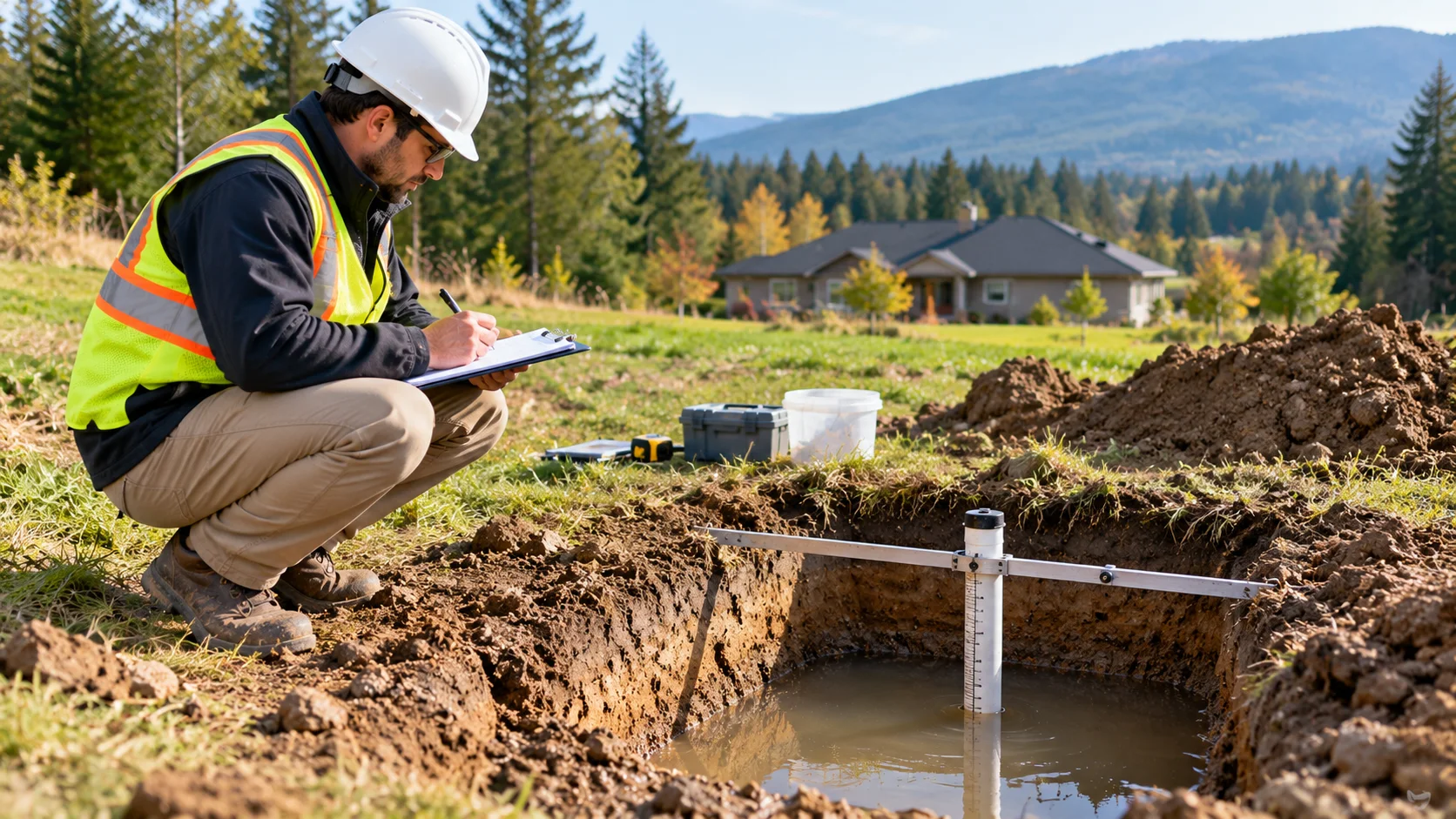
Percolation Testing in BC: Understanding Soil Drainage for Septic Systems
Planning a property development in British Columbia involves more than choosing a building design and preparing the land. Where a property will use an onsite wastewater system, understanding how water moves through the soil is an important part of evaluating whether the site may be suitable for that system.
Percolation testing in BC helps assess how quickly water moves through soil under specified test conditions. The results can inform the evaluation of a proposed septic system, alongside other site information and applicable requirements.
For property owners, builders and developers, understanding this process can help identify potential drainage limitations earlier and support more informed planning decisions.
What Is Percolation Testing?
Percolation testing is a field procedure used to evaluate the rate at which water infiltrates into soil. It is often associated with the preliminary assessment of land being considered for an onsite wastewater treatment system.
Soil types differ in their ability to absorb and transmit water. Sandy soils may allow water to move relatively quickly, while certain clay-rich or compacted soils can restrict infiltration. Actual performance depends on several factors, including soil structure, moisture conditions, layering and groundwater levels.
A percolation test provides useful information about infiltration behaviour at the tested location. However, it does not establish site suitability on its own. The findings must be interpreted with other site conditions and the requirements that apply to the proposed wastewater system.
Why Is Percolation Testing Important?
1. Evaluating Soil Drainage
A key purpose of percolation testing is to understand how water enters and moves through the soil. If infiltration is too slow or site conditions create other constraints, a proposed onsite wastewater system may require further investigation or a different design approach.
2. Supporting Septic System Planning
The soil’s infiltration characteristics can influence the assessment and planning of an onsite wastewater system. Test results may help qualified professionals evaluate possible system locations and identify areas that need additional investigation.
The final design should be prepared or reviewed by the appropriately qualified professional in accordance with applicable provincial and local requirements.
3. Identifying Potential Site Constraints
Some properties have variable soil layers, shallow groundwater, restrictive soil conditions or limited suitable space. A site assessment can help identify these issues before development plans progress too far.
Early identification does not guarantee that a site will be approved for a septic system, but it can help project teams understand where further assessment may be necessary.
4. Improving Development Planning
For rural properties, subdivisions and developments without access to a municipal sewer connection, onsite wastewater considerations can influence how land is planned and used.
Understanding soil and drainage conditions early may help owners and developers coordinate their site plans with wastewater, civil and other engineering requirements.
How Does a Percolation Test Work?
The precise procedure depends on the site, the purpose of the assessment and the applicable requirements. A typical evaluation may involve the following steps.
Step 1: Review the Site
The professional considers the proposed wastewater system location, site layout, visible drainage patterns, topography and available background information. Previous reports or site records may also be relevant.
Step 2: Examine Soil Conditions
The soil profile is assessed to understand the materials present and whether different layers could affect infiltration. Soil conditions may vary significantly across a single property, so the location and number of test areas matter.
Step 3: Conduct Field Testing
Water is introduced into a prepared test area using the procedure required for the assessment. Observations are recorded to evaluate infiltration behaviour under the specified conditions.
Test preparation, timing and measurement procedures should follow the applicable method rather than an improvised approach.
Step 4: Interpret the Findings
The observations are reviewed alongside soil characteristics and other site constraints. The interpretation should account for the limitations of the test and avoid treating a single measurement as a complete assessment of the property.
Step 5: Coordinate the Next Steps
Where required, the findings are shared with the professional responsible for evaluating or designing the onsite wastewater system. Additional investigations may be needed before a final recommendation can be made.
Factors That Can Affect Percolation Test Results
Percolation results should always be considered in the context of the site. Several factors can influence how water moves through the ground.
Soil composition: Sand, silt, clay and mixed soils have different infiltration characteristics.
Soil structure and compaction: Compaction and changes in soil structure can restrict the movement of water.
Groundwater conditions: A high groundwater level may affect whether a proposed wastewater system is suitable for a particular location.
Soil layering: A more permeable surface layer does not necessarily mean that deeper layers will allow water to move freely.
Seasonal moisture: Recent rainfall, wet-season conditions and changes in groundwater can affect observations and their interpretation.
Site topography and drainage: Slopes, low-lying areas, surface runoff and nearby drainage features may influence site planning.
These factors are among the reasons a qualified professional should interpret test results rather than relying on a single number in isolation.
When Should Property Owners Consider Percolation Testing?
Percolation testing or a broader site assessment may be relevant when:
- Planning a new property that may require an onsite wastewater system.
- Evaluating land before purchasing or developing it.
- Considering a new or replacement septic system, where the applicable process calls for soil infiltration assessment.
- Reviewing a rural property where municipal sewer services may not be available.
- Investigating drainage concerns that could affect the proposed wastewater system.
The required assessment depends on the property, the proposed use and the applicable regulatory process. Owners should confirm the requirements with the relevant authority and a qualified onsite wastewater professional before arranging testing.
Percolation Testing and Septic System Approval in British Columbia
A percolation test is only one part of assessing a site for an onsite wastewater system. Approval and design requirements can depend on factors such as property characteristics, system type, soil conditions, setbacks, groundwater and applicable provincial or local rules.
In British Columbia, property owners should confirm the requirements that apply to their project with the relevant health authority and an appropriately qualified onsite wastewater practitioner. Other professionals may need to be involved where geotechnical conditions or development constraints require additional assessment.
A test result should not be treated as automatic confirmation that a septic system can be installed. Site-specific review and the required design and approval process remain important.
How Pacific Geo Can Help With Site Assessment
Pacific Geotechnical Consulting provides geotechnical services in British Columbia, including percolation testing as listed among its services. Its work can form part of the broader understanding of site and ground conditions needed for property planning.
Depending on the project, a site assessment may need to be coordinated with geotechnical investigation, grading, drainage planning and the work of an onsite wastewater professional. The appropriate scope should be confirmed for each property rather than assumed to be identical for every site.
To discuss a project and determine which services may be relevant, visit the Pacific Geo services page.
Frequently Asked Questions
What is percolation testing used for?
Percolation testing measures how water infiltrates into soil under specified conditions. It can help inform the assessment of land being considered for an onsite wastewater system.
Is a percolation test enough to approve a septic system?
No. The result is one piece of information. Site conditions, system design, applicable requirements and the relevant approval process must also be considered.
Can percolation testing be carried out on any property?
Testing can be considered for many types of properties, but the suitable method, test locations and interpretation depend on site conditions and the purpose of the assessment.
Do soil type and groundwater affect percolation results?
Yes. Soil composition, layering, compaction and groundwater conditions can affect infiltration and whether a site may be suitable for a proposed system.
When should I arrange a percolation test?
Consider the assessment during early site planning when an onsite wastewater system may be required. Confirm the testing and design requirements with the relevant authority and a qualified professional.
Who should interpret percolation test results?
Results should be interpreted by a qualified professional familiar with the applicable testing method, site conditions and requirements for the proposed wastewater system.
Conclusion
Percolation testing can provide useful information about soil infiltration when assessing land for an onsite wastewater system in British Columbia. Its value lies in helping professionals understand site conditions and identify questions that need to be resolved before a project proceeds.
Because infiltration is only one part of site suitability, results should be evaluated alongside groundwater, soil layering, site layout and applicable requirements. Early coordination with the appropriate professionals can help property owners and developers make better-informed planning decisions.
For site-specific guidance, contact Pacific Geotechnical Consulting to discuss your project and the assessment services that may be appropriate.