
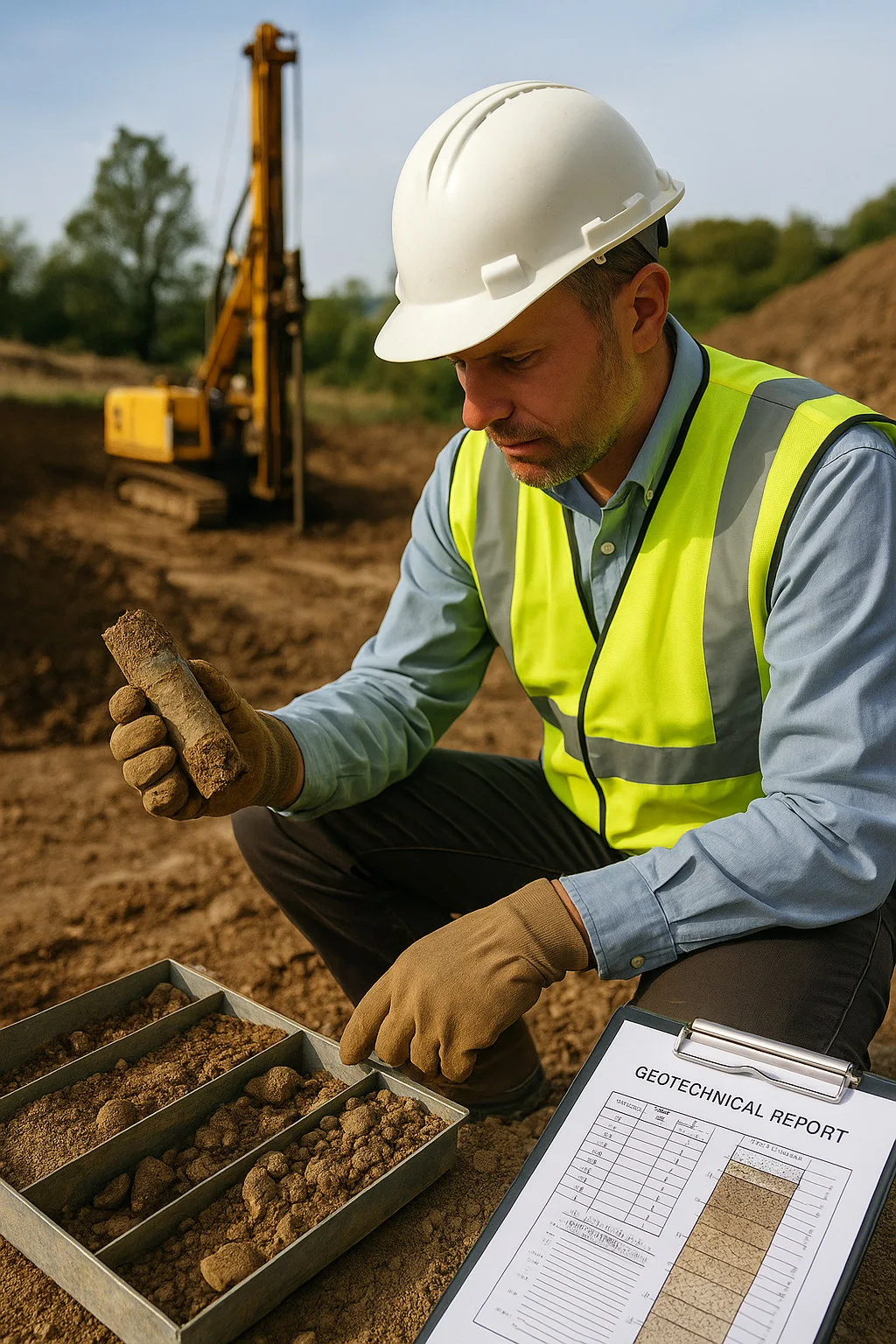
Soil Testing in Surrey, BC: When Do You Need It Before Construction?
Before construction begins, one of the most important questions is often hidden beneath the surface: What is the ground like beneath the property?
Soil conditions can influence foundation design, settlement, excavation, grading, drainage and pavement performance. For this reason, property owners and developers may search for soil testing services near me in Surrey when planning a new construction or development project.
Soil testing is not simply about determining whether soil is “good” or “bad.” The purpose is to obtain engineering information about the ground and use that information to make appropriate recommendations for the proposed project.
What Is Soil Testing?
Soil testing involves examining soil samples and, depending on the project, evaluating the subsurface conditions at a site.
Testing and investigation can provide information about properties such as:
- Soil composition
- Soil strength
- Density
- Moisture conditions
- Grain-size characteristics
- Compressibility
- Bearing characteristics
- Groundwater conditions
- Other engineering properties relevant to construction
The type and extent of testing depend on the project, site conditions and engineering requirements.
Why Is Soil Testing Important Before Construction?
A building ultimately transfers its loads into the ground.
If the soil conditions are not properly understood, the design team may have limited information about how the site will respond to construction.
A geotechnical investigation and appropriate soil testing can help identify conditions that may influence:
- Foundation design
- Settlement
- Excavation
- Earthwork
- Site grading
- Pavement design
- Drainage
- Slope stability
The information can then be incorporated into the project’s geotechnical recommendations.
When Should You Get Soil Testing in Surrey?
Soil testing may be appropriate for many different types of projects.
Building a New Home
If you are planning a new home, understanding the supporting soil can help inform foundation recommendations.
The investigation may identify variations in soil conditions, existing fill, groundwater or other factors relevant to the proposed construction.
Building a Townhouse or Multifamily Development
Larger residential projects can involve multiple foundations, extensive grading, underground services, parking areas and other site improvements.
A broader geotechnical investigation may therefore be required to understand conditions across the development site.
Developing a Commercial Property
Commercial buildings, parking lots and access roads can impose different loads on the ground.
Soil investigation can provide information needed for foundation and pavement planning.
Planning a Subdivision
Subdivision projects can involve multiple lots, roads, grading and infrastructure.
Geotechnical information can help identify ground conditions that may affect development across the property.
Constructing on a Sloped Property
Sites with significant changes in elevation may require additional assessment of slope stability and ground conditions.
Planning Major Excavation
Deep or extensive excavation can require an understanding of soil and groundwater conditions before work begins.
What Happens During a Soil Investigation?
Soil testing is normally part of a broader geotechnical investigation rather than an isolated laboratory exercise.
The exact process depends on the project.
Step 1: Review the Project
The geotechnical engineer reviews information about the property and proposed construction.
This may include site plans, building layouts, grading information and other available project documents.
Step 2: Visit the Site
A site reconnaissance allows the engineer to observe existing conditions.
The review may consider:
- Existing structures
- Surface drainage
- Topography
- Slopes
- Visible fill
- Access
- Adjacent properties
- Other site features
Step 3: Investigate the Subsurface
Depending on the project, subsurface exploration may involve:
- Boreholes
- Test pits
- Soil sampling
- Other appropriate investigation methods
The objective is to understand the materials below the surface.
Step 4: Collect Samples
Soil samples may be collected from different depths for laboratory analysis.
The number and type of samples depend on the investigation scope and site conditions.
Step 5: Perform Laboratory Testing
Laboratory testing can be used to determine engineering properties relevant to the proposed development.
Not every project requires the same tests.
Step 6: Analyze the Results
The geotechnical engineer combines field observations, subsurface information and laboratory results to assess the site’s engineering conditions.
Step 7: Prepare Recommendations
The findings may be documented in a geotechnical report containing recommendations relevant to the proposed construction.
What Can Soil Testing Tell You?
The exact information depends on the investigation and testing program, but soil testing may help engineers evaluate several important issues.
Bearing Conditions
The engineer can assess whether the soil provides appropriate support for the proposed foundation system.
Settlement Potential
Some soils can compress under additional loading.
Understanding soil characteristics can help engineers evaluate potential settlement and provide appropriate recommendations.
Soil Variability
A property may contain different soil materials at different locations or depths.
Testing can help identify these variations.
Groundwater
Groundwater conditions can influence excavation, drainage and foundation construction.
Earthwork Requirements
Soil characteristics can influence whether excavated materials are suitable for reuse or whether engineered fill may be required.
Pavement Support
For roads and parking areas, subgrade conditions can be important considerations in pavement design.
Does Every Property in Surrey Have the Same Soil?
No.
Soil conditions can vary significantly between properties.
A site’s ground conditions may have been influenced by natural geological processes, previous grading, imported fill, drainage and earlier development.
Even nearby properties should not automatically be assumed to have identical subsurface conditions.
This is why site-specific investigation is important when engineering recommendations are required.
Soil Testing for Residential Construction
For a residential project, the appropriate investigation depends on the property and proposed construction.
Factors that may influence the scope include:
- Building size
- Foundation type
- Site topography
- Existing fill
- Groundwater
- Slope conditions
- Proposed grading
- Local development requirements
A qualified geotechnical engineer can determine the appropriate investigation based on the project.
Soil Testing for Commercial Developments
Commercial developments can have more extensive site requirements.
A project may involve:
- Large building foundations
- Parking areas
- Loading zones
- Underground services
- Significant excavation
- Extensive grading
Soil investigation can provide information needed to coordinate foundation, earthwork and pavement-related engineering.
What Is the Difference Between Soil Testing and a Geotechnical Investigation?
The terms are sometimes used interchangeably, but they can describe different parts of the overall process.
Soil testing generally refers to testing soil samples to determine specific properties.
A geotechnical investigation is broader. It may include site reconnaissance, subsurface exploration, sampling, laboratory testing, engineering analysis and preparation of a report.
In other words, soil testing may be one component of a complete geotechnical investigation.
Can Soil Testing Help With Foundation Design?
Yes.
Foundation design needs to account for the supporting ground.
Geotechnical information can help the project team evaluate issues such as:
- Bearing capacity
- Settlement
- Soil variability
- Foundation depth
- Groundwater
- Excavation conditions
The geotechnical recommendations are coordinated with the project’s structural design.
Can Soil Testing Identify Settlement Risk?
Soil investigation can help identify ground conditions that may contribute to settlement.
However, settlement is a site-specific engineering issue. The amount and type of settlement depend on factors such as soil properties, loading, groundwater and the proposed development.
Testing does not mean that every future movement can be predicted with absolute certainty. It provides engineering information that can be used to assess the site’s conditions.
What Happens If Unsuitable Soil Is Found?
Finding unsuitable or problematic material does not necessarily mean a project cannot proceed.
Depending on the circumstances, engineers may consider approaches such as:
- Removing and replacing unsuitable material
- Engineered fill
- Ground improvement
- Alternative foundation systems
- Changes to grading
- Other project-specific measures
The appropriate solution depends on the soil conditions and proposed construction.
Soil Testing and Earthwork
Soil information can also be important during site grading and earthwork.
Engineers may need to evaluate whether excavated material is suitable for reuse and what requirements apply to placed fill.
Earthwork recommendations may address:
- Fill materials
- Compaction
- Subgrade preparation
- Excavation
- Soil reuse
- Grading
- Construction considerations
This information can help contractors and project teams plan site preparation.
Soil Testing and Pavement Design
Roads, parking lots and driveways rely on the material beneath the pavement structure.
Subgrade conditions can therefore influence pavement design.
A pavement assessment or design may consider:
- Subgrade conditions
- Expected traffic
- Existing pavement
- Drainage
- Material requirements
- Site conditions
Soil investigation can provide useful information for this engineering process.
How Much Does Soil Testing Cost in Surrey?
There is no single price for soil testing because the cost depends on the scope of work.
Factors that may affect the cost include:
- Property size
- Project type
- Number and depth of boreholes or test pits
- Accessibility
- Laboratory testing requirements
- Site conditions
- Groundwater
- Reporting requirements
- Project complexity
A residential investigation may have a different scope from a large multifamily or commercial development.
The best way to determine the appropriate cost is to provide the geotechnical consultant with information about the property and proposed project.
How to Choose Soil Testing Services Near You in Surrey
When comparing geotechnical consultants, consider more than the laboratory testing itself.
Ask:
- Will the project receive a site-specific geotechnical investigation?
- What investigation methods are proposed?
- What laboratory testing is required?
- Will the findings be included in a geotechnical report?
- Will the report provide foundation recommendations?
- Can the consultant assess earthwork and excavation requirements?
- Can they support pavement design where required?
- Do they provide construction field reviews?
- Does the firm have experience with similar Surrey projects?
The right scope depends on the project rather than a standard package for every property.
Soil Testing Services in Surrey, BC
Pacific Geotechnical provides soil testing and geotechnical investigation services in Surrey, BC, supporting residential, commercial, industrial and development projects.
Its broader geotechnical services include:
- Geotechnical site investigations
- Geotechnical reporting
- Foundation design
- Earthwork and excavation design
- Pavement assessment and design
- Slope stability analysis
- Geotechnical assessments
- Due-diligence geotechnical studies
- Construction field reviews
Pacific Geotechnical primarily serves Metro Vancouver and the Lower Mainland, with projects in other areas of British Columbia considered based on project requirements.
Frequently Asked Questions
Do I need soil testing before building a house in Surrey?
The need and scope of soil testing depend on the property, proposed construction and applicable project requirements. A geotechnical engineer can determine what investigation is appropriate.
How long does soil testing take?
The timeframe depends on the size and complexity of the project, site access, investigation methods, laboratory testing and reporting requirements.
Is soil testing the same as a geotechnical report?
No. Soil testing is generally one component of a geotechnical investigation. A geotechnical report brings together site observations, subsurface investigation, testing and engineering analysis.
Can soil testing detect groundwater?
A geotechnical investigation can provide information about groundwater conditions when the investigation scope and methods are appropriate for evaluating groundwater.
Does soil testing help determine foundation type?
Geotechnical information can help evaluate the supporting ground and provide foundation recommendations. The final structural design is coordinated with the project’s structural engineering requirements.
Can soil testing be done after construction starts?
It is generally preferable to investigate relevant ground conditions during the planning and design stage, before major construction decisions are finalized.
Does Pacific Geotechnical provide soil testing in Surrey?
Yes. Soil testing and geotechnical site investigation are among the services provided by Pacific Geotechnical.
Understand the Ground Before You Build
Construction begins below the surface.
Whether you are building a home, developing a townhouse site, constructing a commercial property or preparing a larger subdivision, understanding the soil and ground conditions can help the project team make better-informed engineering decisions.
If you are searching for soil testing services near you in Surrey, the appropriate first step is to discuss your project with a qualified geotechnical consultant and determine what level of investigation is required.
Pacific Geotechnical provides site-specific soil testing, geotechnical investigation and engineering services for construction projects in Surrey and throughout its service areas in British Columbia.
Contact Pacific Geotechnical to discuss your soil testing or geotechnical investigation requirements.